Painting Itself / 绘画本身, curated by Jonathan Nichols at the Perth Institute of Contemporary Arts, brought together five painters from Hong Kong, Malaysia, London, Shanghai, and Singapore to explore how contemporary painting is being reimagined through East and Southeast Asian perspectives. In this collaborative piece with the Dispatch Review, we bring you our interviews with Nicholas as well as two of the exhibiting artists, Un Cheng and Chris Huen Sin Kan to talk about their practices and work. To see our interviews exhibiting artists, Noor Mahnun and Jon Chan, please head over to Dispatch Review. We thank all at PICA, in particular Jonathan Nichols and Susan Atkins, as well as all the exhibition artists, for their time. Please Enjoy.
William Bromage: Could you talk a little bit about your inclusion of Tang Dixin’s work in this exhibition?
Jonathan Nichols: Well, he’s never been shown in Australia, which I think is pretty incredible given how strong his work is. We can see an example of this in this piece [Yellow Peril], which I think really speaks for itself: the figure is play-acting as an Asian man, making an “Asian” face, in what appears to be a mirror. But of course, it's a painting. It's pretty harmless, but when the billboard [used as the exhibition’s promotional image] went up, there was a lot of strife.
Felicity Ostergaard: We were actually going to ask about that. What was the motivation behind choosing Yellow Peril specifically?
Jonathan Nichols: Oh, you'd have to ask the staff. When we were framing this up, we had five-to-ten works to choose from. But I can see how some people view this work as a form of patronage in this country, since it has never been seen outside of Asia. But while I get it, it indicates a Western stereotype. Having known a few Chinese people who saw it exhibited in Shanghai, I also see, you know, that there’s an attitude there too. It's a complex work.
I think Tang’s work is fluid and quick to arrive at its message. He has a certain willingness to address people more directly. That was the quality that I was interested in. And we can see this in another example of his work here [On the Lake]. So, this work was painted in 2014. When I first looked at it, I thought it felt very calm. To be frank, it's beautiful. There's a small boat on the lake, then there's a reflection, and then there's this cargo on the boat. This cargo is, in fact, two figures whose outline resembles a mountain. And in the history of painting, in the West as well as in China, landscapes convey a sense of aspiration. So, a mountain shape is a story about aspiration and climbing to the top. But when you get closer and start examining what these guys are doing in the boat, you realise it’s very ambiguous. Suddenly, this very calm scene strikes me as a murder scene. It seems like one of the figures is drowning the other. So, you could say that much of Tang's work is dramatic and confronts its viewers. I’ve seen a lot of artwork in Australia, and this kind of thing is just not around. It’s very unusual.
Here is another example of his work [On the Mountain]; it was painted about five years after [On the Lake] and is a landscape. You can see it resembles a figure; the landscape resembles a body. I think it’s a little bit like Mount Rushmore or something like that. It's just strange—it’s like the body has collapsed into the land. And if you think about it again, in Australia, while you do have these kinds of Western landscape traditions, they don’t resemble this. However, in Aboriginal practices, there is this kind of landscape knowledge, and in many, many respects, so do the Chinese. So, I think there is something shared there.
When I was talking to Tang about the catalogue, I pulled up a Caspar David Friedrich picture off the internet. Through translation, I said, ‘Yeah, does this work?’ And he goes ‘Oh, yeah, you know kind of’. But there's another work of his that sort of does it as well, in which there’s a hunched-over figure looking at the horizon line, which made me remember those pictures of monkeys climbing to the tops of trees and looking at the sun going down. And so, it's not just one work that's making you think about all these different things.
William Bromage: Could you talk a little bit about the show and the thinking behind it?
Jonathan Nichols: Now, the concept for the show is only 13 paintings and five artists. I'm super aware that a show like this hasn't happened in this country. I don't know why that's the case, and I feel as though the system is deficient. Indeed, we are well out of a moment, of you know, let's call it modernism, postmodernism, or art history, or something where the codes were defined by the big towers, usually an American one, and usually a European one. While we are over that, here in Australia, you still have to travel in your mind, using the artwork you've got. You can't just parade these old ideas about what was best and what wasn't. So the logic I've used to bring these artists together is a kind of studio logic that many painters use. In a way, I think it's a game of reflection and seeing the work like themselves.
Painters self-identify as they see fit: they see a face and then look for the face in the painting. And through this process, the painting has its own face. It's a kind of self-recognition. It’s a very familiar methodology in studios, where, if you talk to artists, they'll say things like that guy, he paints more anthropomorphic; so while you speak as an artist, the painting also speaks like a person. It’s like there are two voices in painting. There's the artist's voice, and then there's the painting’s voice. And that idea, which I track back through, you know, has roots within Western philosophy. And it's well known to painters like Paul Klee, who worked in the Bauhaus and would articulate things in this way. And there are many others. But it's not just a Western concept; it's an idea or a way of thinking about painting that also occurs in other cultural spaces. So all of a sudden, here we are in Australia, and I want to traverse some borders and some cultural practices, right? And I'm using a way of making paintings that travel across these kinds of breaks. That was really the logic.
So the title of the exhibition, Painting Itself, is a Chinese interpretation of a translation. I don't read Chinese, but it's symbolic that this is not just understood in English, or even, let's go one step further, in Chinese as the lingua franca. As soon as you get to Singapore, there’s Mandarin. So, this exhibition is saying maybe we need to address these gaps.
Felicity Ostergaard: Actually, we were speaking about it before: in the Australian art world, even with its proximity to China, it largely ignores its northern neighbours.
Jonathan Nichols: I think so, in a funny way, the art world can be very conservative. They go to art school, but they're not wholly trained. While they learn about art, they study art history and repeat it. I think they've got to turn their eyes now and look north, and certainly they've got to look across, independent of these histories that I think are completely flat. We can go, well, there's an important artist. But it is painters who really write art history. It doesn't come in books. You paint the picture. The painting comes first. So what we understand as art history has been defined by the painters who write it.
In Australia, I can barely name one serious art critic who's got a bit of tenacity. All the rest are long gone, you know? They've disappeared. They're like dinosaurs that have fallen off the page. Because they can't talk about modernism anymore. And in an exhibition like this, the tropes of modernism—say figuration or abstraction—I'm kind of not interested. I'm just not interested in going into that space. I mean, you could try and bring that into these works and go, ‘Oh, I understand what's going on,’ as if you're dragging things around and printing your stuff on it. So, there are a lot of gaps there.
If we look at this work over here [by Un Cheng], we can see some of these things I've been discussing. Un Cheng was among all the democracy marches in Hong Kong, amid the collapse of democratic hope. In that moment, politics had changed monumentally. She was just a young artist, only a couple of years out of art school, when she went through 18 months of street marches and everything that comes with that. So this work, from that time, is called Beer, Weed and Spinach, referencing the fact that she was drinking too much and smoking too much, right? But here's the question. So, I see this as a kind of window into her exhaustion, a collapse. Now this is not an articulated collapse. Nor is it merely a physical collapse. Rather, it’s a depiction of her falling apart after the failure of two years of thinking something was viable. She, in fact, talks about waiting for a hero at this time. And in a Western tradition, somebody might have come along and said, Oh, this is very existential, so they would paint it black. But this isn't a black picture. The colours come from her bathroom. Its central motif, a toilet, is very hard to pull off with any credibility. I mean, we know Duchamp put the toilet or the urinal in the centre stage, but I don't think that was what was going on here. Rather, it's the painting itself that speaks, but it's also kind of in the background. Both these elements talk together.
Un is with Blindspot Gallery, and they've been really helpful in getting her here. Blindspot has impressed me because I think it's different from those galleries that try to jump to the higher ‘trade’ as soon as they can. Those galleries you know, they're in the market a bit, but in the process, they lose sight of contemporary practice. But I think Mimi Chun [owner and founder of Blindspot Gallery] is just doing really good things. And we’ve talked in our interviews [with Mimi and Un] about leadership, which is an odd phrase. None of us believes it really. But you know, in the art world, there is this notion that thinks a city like Hong Kong can now lead the art world. I think it's because there's still a kind of stress, tension, and opportunity in Hong Kong, which is the kind of possibility the art world looks to. But if that's all going to come about, then it's people like Mimi Chun and blind spot that are going to be in the mix. But when we talked about it, I think you said the Hong Kong art world is a bit headless because it's hard for people to know where to go politically and how to structure things.
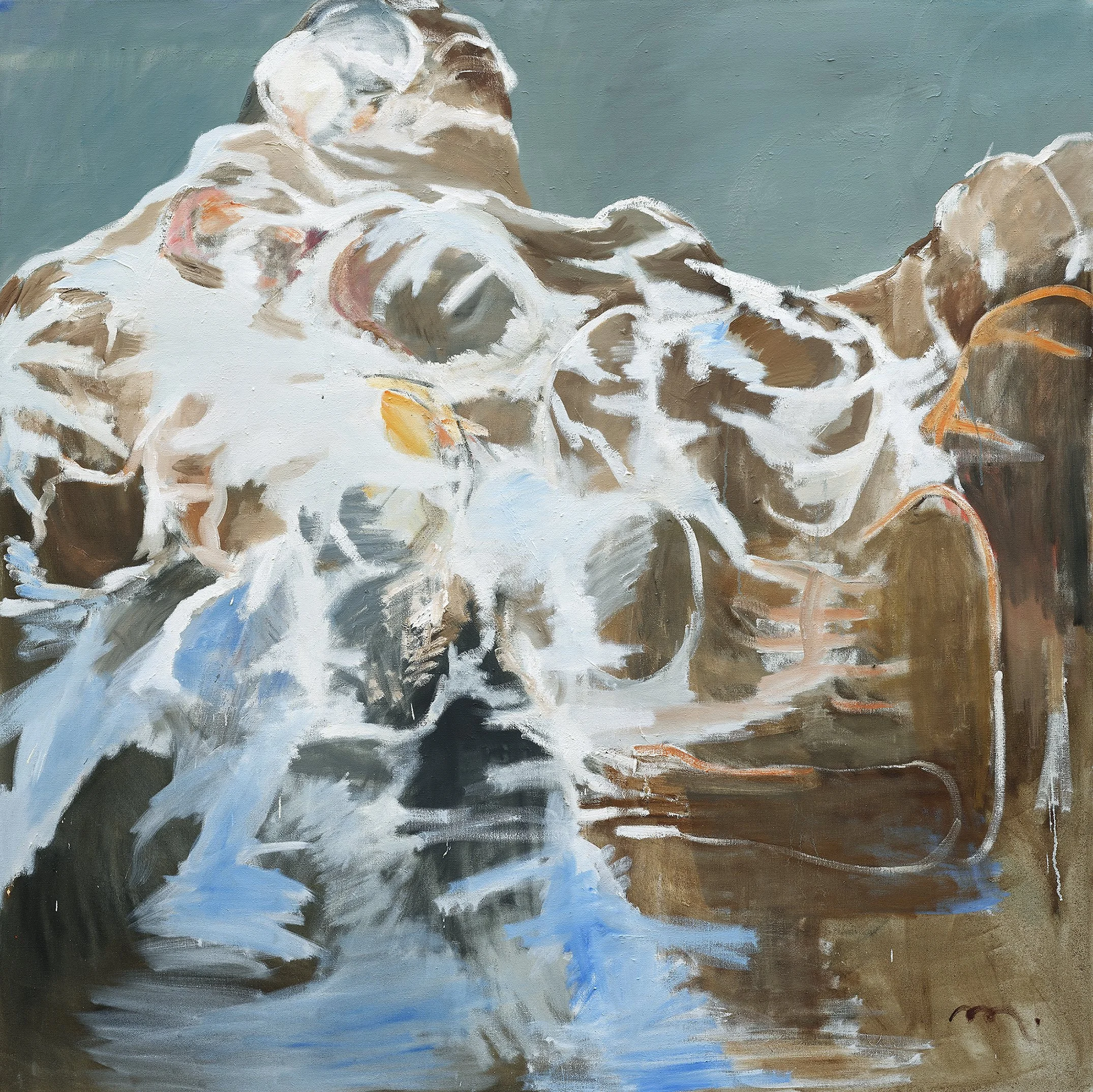
Tang Dixin, Human Mountain, 2013.
Courtesy of Ota Fine Arts.
William Bromage: Could you talk a little bit about your work?
Un Cheng: So here we have two pieces of my work. This [No Bargain $10!] is one kind of self-portrait that I started making in 2021. That one was made two years later and is a portrait of a grandma tending to her fruit, which she sells on the street. I have a story behind each of my works, but we'll start with No Bargain $10!
It came from a very random conversation I had with a grandma who asked me for a $10 discount on some flowers. Her sense of humour about it, I thought, really represented the attitude of not only people in Hong Kong but also of growing old—the “granny personality”, as I call it. Even though I live in a less urbanised part of the city, people think of Hong Kong as a highly compacted city with all these buildings. But I actually feel a connection to the city's “countryside.” You can see this in the painting, using grey-green and green-pink colours. I also really like using my signature purple-black combo because it helps with the technical aspect of drawing floor patterns. But anyway, I feel a connection every time I see an older person. With most of my work, I wouldn’t say it's isolating; it comes from my everyday experience. Out on the street, I really easily notice people or things that I think stand out or are left abandoned, such as drug addicts or people from different backgrounds in love. So I feel this painting depicts daily life in Hong Kong.
This other one, however, is more like a self-portrait. I made it in 2021 during the [pro-democracy] protests in Hong Kong. It's part of a triptych, which is a motif I use a lot in my work. The other works in this specific triptych have a more yellow colour palette, but this one is more positioned within a ‘girls’ setting. The other works include a depiction of a figure taking objects from the street to make a roadblock and a portrait of a journalist holding a skateboard. But this specific work is titled Beer, Weed and Spinach. I was so frustrated at that time, one night, I began to throw up, hence the spinach. I was quite surprised to see it again.
Everything was so devastating that day, but I saw this ‘hole’, and it was me. That shows in the colours that I use. So while I paint, some questions come up that I ask myself, like, can I make it very pink? Does it feel harmonious? How many colours can I include? So I intentionally make these contrasts to create the composition that I really want. Therefore, the colour contrasts ensure my work isn’t overly negative and that it evokes a sense of peacefulness. I don't want to create too much of a depressive atmosphere. So I also use softer lighting and different brush strokes to counteract this. When I have stronger emotions, my brush strokes become more prominent.
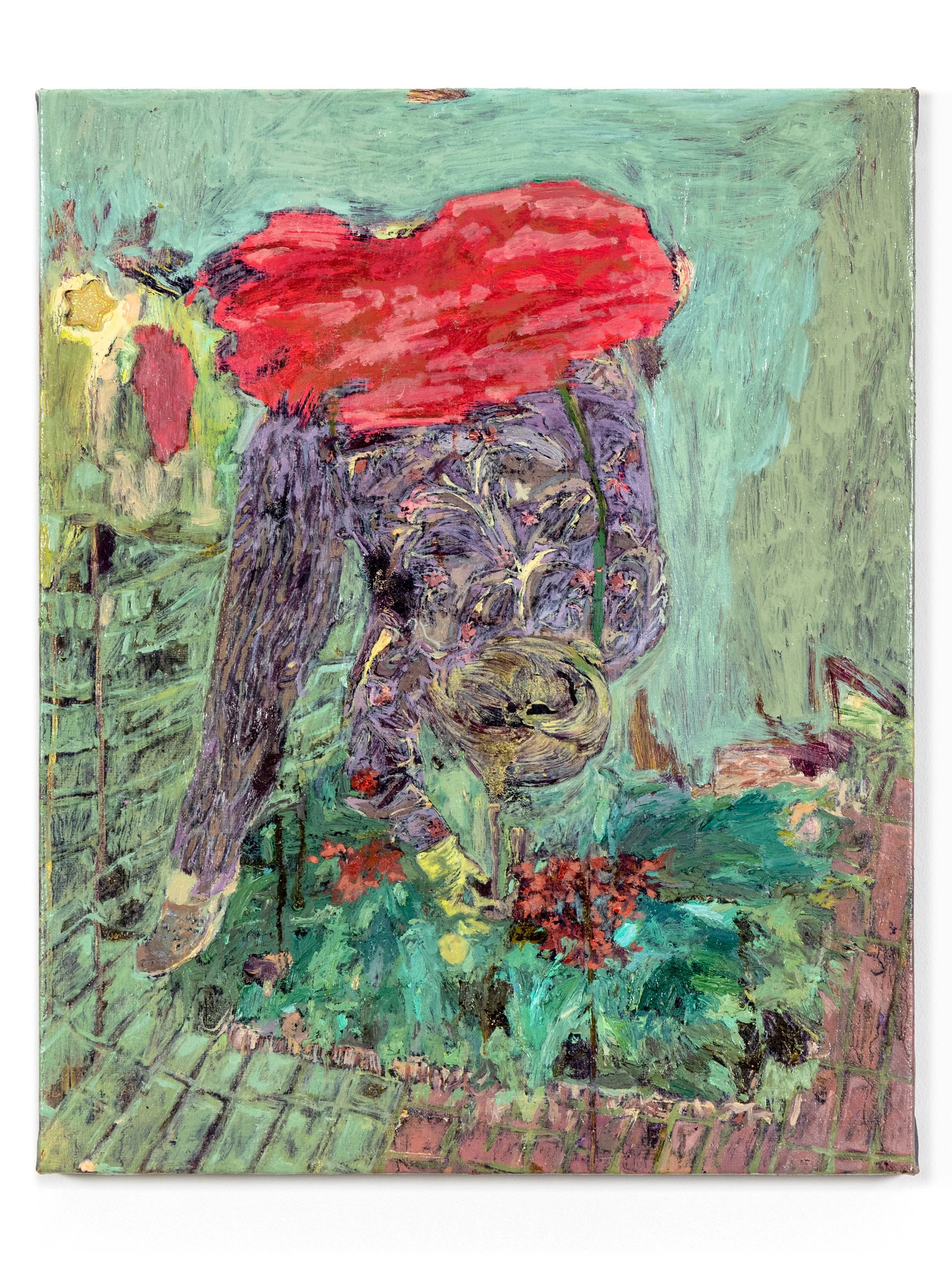
Un Cheng, NO BARGAIN $10!, 2023.
Image courtesy of the artist and Blindspot Gallery, Hong Kong.
The human figures that I draw are also very spontaneous. They mostly come from my emotions, my mood, and the memories that I had from that time. Even though it's quite grainy, you can see this in the two additional figures I include. That’s in fact shit in the toilet.
However, while trying to make my work more granular and more spontaneous, I always try to make the composition quite straight. This ensures that there's a clear delineation between the positive and negative spaces for comparison.
Felicity Ostergaard: So, obviously, there are a lot of layers in the work. Do you sort of plan out your renders of the composition ahead of time, or do you go with the flow of the painting?
Un Cheng: I don’t do many sketches before I start to paint, but there are a few phases in my process, like deciding on the colours and brushstrokes. I like really abstract paintings, so I try to make different kinds of tools to paint with, from making my own brushes to stretching the canvas, to maybe using a wooden bar from some event. So, I think in the first phase, I try to be very expressive. And when I have the colours that I like, I start thinking about the composition. But the composition in terms of whether it's indoor or outdoor. So let's say this one, I feel like it's an indoor one. But there is also a composition: a triangle or something like this. After that, I go with the flow.
Felicity Ostergaard: Regarding your use of colours, you said you wanted them not to convey dark, depressing themes. In this process, do you draw the colours from the actual space itself or from somewhere else?
Un Cheng: You need some reference for some things. For myself, I watch a lot of Japanese anime, like JoJo's Bizarre Adventure. It's quite popular in my province. So at times you have to connect with these kinds of child-like things to make people feel connected to a sense of innocence and instruction.
Felicity Ostergaard: Did that inspire your choice to include physical objects like this toy star in your work?
Un Cheng: Yeah, I mean, in some of my works, I will include something around me, like a stamp, a piece of paper or in this case, something off my slipper. I think of it as creating a visual diary that connects my ideas with my voice. As if to say that there is stuff happening in my daily life, I draw on not only my mental but also my physical resources. So, yeah, it can be very unique,
Felicity Ostergaard: We noticed that in a lot of your works, you use things like bricks or tiles; these quite spare shapes, which emphasise these lines. Is that something you do on purpose?
Un Cheng: I think maybe this comes from the consciousness of my consciousness. Because I mean, Hong Kong has many buildings and skyscrapers. So I do feel really conscious of my memory, and how that reflects in my use of lines, particularly in my interiors. Space always reflects a general atmosphere for me. But colours are more accurate in detailing specific things. As in China, the colours in a painting have a similar effect to ink. But yeah, the mood of my paintings is always related to space, and the different lines I use. But in this one, I use some colour layers to compare and highlight the line's contrast. But some are really neutral in their message. So in a way, there are two different ways of doing things, like different body movements or different thoughts. Two different interactions are going on.
Felicity Ostergaard: Could you talk about some of the works you have in this exhibition?
Chris Huen Sin-Kan: So, usually I wouldn't talk about, like, a specific work, but rather my practice as a whole. My practice is always about the ordinariness of life, so my work is woven into my daily routine. Like, when I wake up, I drop the kids off at school, then I take the dogs to the forest for a walk. And after that, I go back to the Studio and start working. Basically, I like to paint my daily routine over and over, revisiting it day by day. In this way, my works become an accumulation of my thoughts and memories; there is a constant refresh. In this sense, I get to convey this passage of time. The figures in my work are actually my wife, my children, and sometimes my dogs. I think this reflects the fact that all works on display are about a single period in my life.
Very recently, one of our dogs passed away. So, slowly but surely, she was phased out of my thinking because she was no longer physically there. But I guess that’s what I intended to do. I wanted to face and highlight these subtle changes in my life. Like when my kids start growing up and become teenagers, they might stop being in my painting. But hopefully, they will come back and will bring more members to the family. But maybe later on, at the end of my career or the end of my life, there will only be my wife and me. So, that’s the kinda’ story I want to tell.
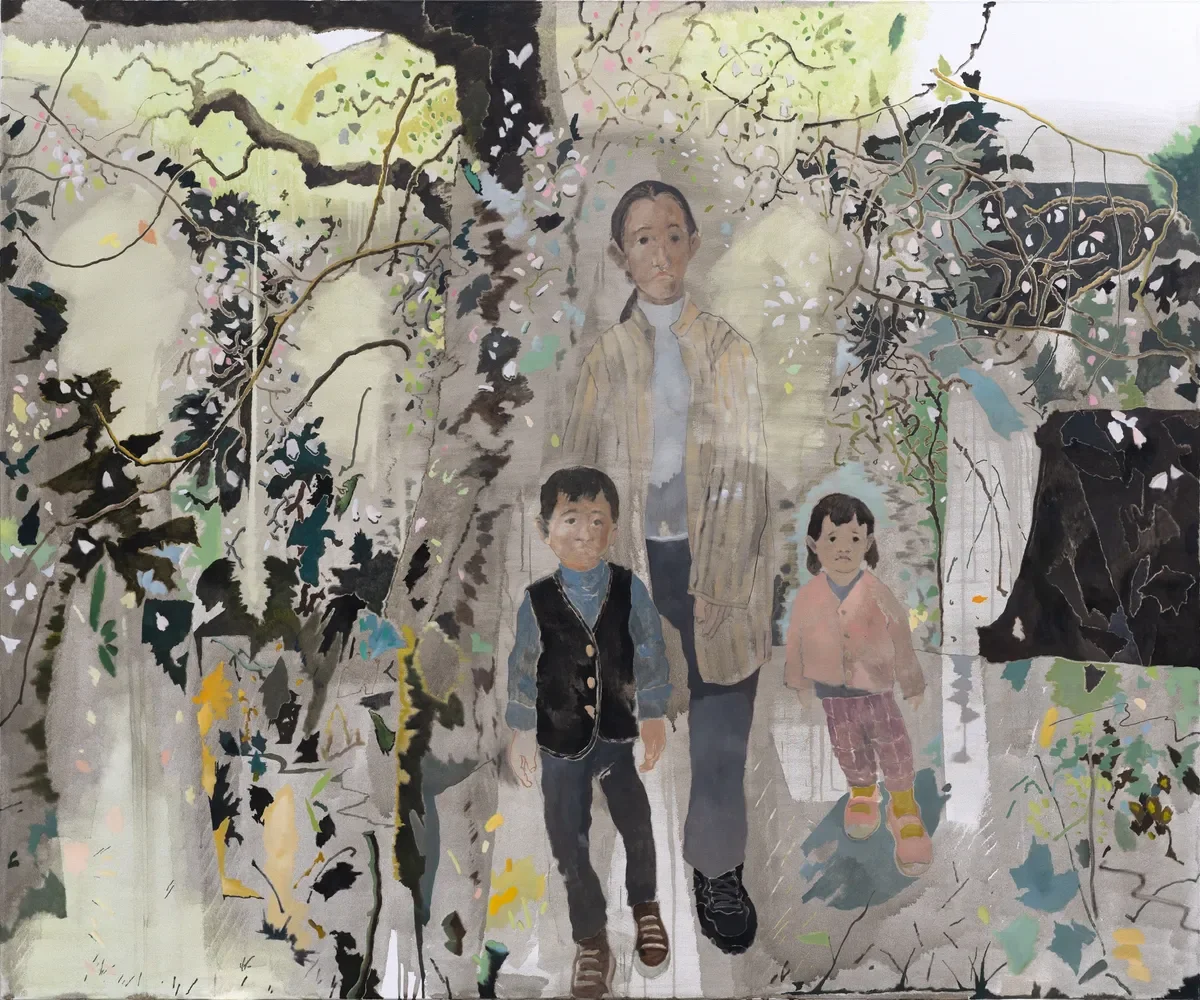
Chris Huen Sin-Kan, Haze and Tess, 2023.
Courtesy of Ota Fine Arts
Felicity Ostergaard: Given the exhibition's context, with paintings featuring faces, I noticed that your family and even the dogs are all making eye contact with the viewer, which I found really interesting. Would you say that's more them making eye contact, or is it also the painting making eye contact? Would you say they're separate things? Where do they merge and interact?
Chris Huen Sin-Kan: So in the beginning, when I painted them, they weren’t looking. But then I always felt like something was missing. So I thought, what if they look back? Once I did that, I felt a sense of connection between these interacting “observers”. Like when we see the painting, they're looking back. Given also its life size, it also adds to this sense that we are looking in, but they are also looking out. Through this, I can make a connection between the painted space and the space we were in.
I feel that when we look at a painting, and even sometimes when I'm working on one, it almost becomes merely an object. But by adding this sense of connection, it becomes more like a space that you’re thrown into, rather than just an object to observe.
Felicity Ostergaard: Is this part of the reason why your paintings are life-sized?
Chris Huen Sin-Kan: Yeah, because I think that's a big reason why I like to paint on larger scales. But also, a large part of that is because I'm not trying to depict the objects within, but rather the experience of being in this space or place, and how that influences how the things around it unfold. So the larger scales allow the painting to wrap around the viewer and occupy their focus.
William Bromage: I was going to ask because, I mean, I notice that in a lot of your paintings, the figures you describe are not only always front and centre, but their features remain consistent and detailed. But the objects around them are really hard to make out. Could you talk a little bit more about how your memory shapes that relationship and the experiential aspect of your work?
Chris Huen Sin-Kan: I always say, when you try to imagine a tennis ball, there are always a few characteristic features you think of, like it being green and having a U-shaped line and so on. This highlights that when we try to reconstruct and communicate things to others, it's always drawn from our memory and understanding. And this means it seems pretty easy to describe things like a tennis ball or even a glass of water. Yet there's also a lot of underlying nuance in this process. What if you think of a different version of that same thing from a separate time in your life? Like the tennis ball or the glass of water is not the same every time. Perhaps the shape is different, like a wine glass. So there is a lot of nuance to this process, and when it comes to the lived experience within the paintings, it's not concrete—rather, it's a process of interaction between new and old memories.
So the figures, for me, are kind of like an anchor point, because they’re always the people or the animals that are the closest to my heart. But for a lot of people, they’re just strangers. You don't even know them. I had this experience a lot when I was a kid, actually. I would go to the museums in Hong Kong and later in London, and I would see portraits of famous and/or noble people. Yet I didn’t know anything about them; I felt like they were so far away. When I looked at them, I knew they existed, but I could never connect to their lived experience. I could never get a sense of somebody’s experience of what they were. So, as an artist, trying to describe everything around me is like planting a seed. Everything starts to grow from that point, like the trunks start to come up, and then, you know, there's the roots, and then the branches, and so on.
Felicity Ostergaard: Was there a big change in your style when you moved from Hong Kong to London because of the different surroundings?
Chris Huen Sin-Kan: I think so, because there is a big geographical difference. So I started to notice many differences in my sensations, especially in the colours around me and in the climate. Different greenery started to appear in my daily routine. But I try to incorporate these changes naturally into my work, not to force them. I try not to think about it too much. I tell myself you're still you. It's not like you spend 30 years in your hometown and then, when you move to another place, you suddenly become a different person. So I think change in my work happens slowly but surely. It's like the family structure, you know, it changes subtly. But I wouldn't say it's a style; rather, it's how I react and respond to the changing environment around me.
William Bromage: I was wondering, given that a lot of the works in this exhibition are exploring this relationship between truth and experience, what do you think of this relationship in your own work?
Chris Huen Sin-Kan: I think it's like, we build up an idea of how things are. We have many presumptions about how things work. But in fact, I always feel like the nature of things is always changing. There is a certain ferocity and uncertainty about things. So yeah, I don't know if I would say my work explores truth so much as how we understand life.